Saturday, 11 April 2015

Turkish BALO Train had an accident with EURO City Passenger (Video)

Turkish BALO Train had an accident with EURO City Passenger
Turkish BALO Train had an accident with EURO City Passenger :Nobody was killed in the crash, but at least 35 people were injured as two of the passenger train’s carriages, carrying 110 people on board, were overturned the operator Deutsche Bahn said.
Five of the victims are in serious condition.
Mannheim’s fire department said the collision could have taken a more serious toll, if the trains were not travelling at a relatively slow speed due to proximity to the central station.
Turkish BALO Train had an accident with EURO City Passenger-1
The accident happened around 9:00pm (1900 GMT|) and led to the derailment of five carriages of the passenger train, which was taking some 250 people between Graz in Austria and the German city of Saarbrueken near the French border.
Earlier in the evening the rail company said that the evacuation of the train had been completed but that Mannheim station remained closed.
The goods train involved in the crash belonged to the ERS Railways group and was travelling to Hungary.
Turkish BALO Train had an accident with EURO City Passenger

Friday, 10 April 2015

Forbes​BrandVoice 
Connecting marketers to the Forbes audience. What is this?
BUSINESS  11,180 views

Apple Watch Predicted To Be Shining Star In Crowded Smartwatch Scene

By Andreas Schmitz, Senior Editor, SAP News Center
With demand for tablets and smartphones stabilizing, manufacturers are hoping to see the market for smartwatches take off in 2015. And they have every reason to be optimistic: A predicted 10.8 million smartwatches will ship this year in the U.S. alone.
Once again, the wearable technologies of the moment were in strong evidence at this year’s Consumer Electronics Show in Las Vegas. Wristbands that flash when a call comes in; smart glasses that sense when the wearer is getting tired; and a veritable swarm of “smartwatches,” or intelligent wrist-worn devices that will one day park your car for you or remotely control your domestic heating system and window blinds.
watch
According to the latest figures from the U.S. Consumer Electronics Association (CEA), smartwatches will be the top-selling devices in 2015. The CEA predicts unit sales of 10.8 million in the U.S. this year – three and a half times the figure for 2014. Moreover, market researchers expect sales of smartwatches to hit €2.6 billion in 2015, which is four and a half times last year’s total. That figure accounts for more than half of the total projected revenues from wearables in Europe in 2015 (€4.55 billion) and represents an increase of 22% on 2014.
Apple AAPL +0.76% Watch expected to sell well
The long-awaited Apple Watch, set to become the star on the smartwatch scene, is due for release very soon. Analysts from U.S. investment consultants Evercore are forecasting that sales of the Apple Watch alone will be close to €7.8 billion in 2015.
“Apple will position its smartwatch as the must-have product,” predicts Rouven Hohendorff, an innovation analyst at Hamburg-based trend research specialists TRENDONE.

Apple Watch promises a number of compelling innovations, including a gentle vibration to notify the wearer of an incoming call and the ability to function as a cash card and access card in one. “The watch also detects its owner’s pulse,” explains Hohendorff, who has been conducting “micro-trend” research, the search for innovations that impact a single industry, at TRENDONE for many years. The research specialists publish their selection of the 250 most compelling innovations every month. If topics can be clustered, then a micro-trend becomes a “macro-trend,” as is the case with wearables.
“Two years ago, innovations in the wearables domain were few and far between,” observes Hohendorff. “Today, one in every 10 of the innovations we identify is connected with wearable technology in some way.” Wearables include items of clothing such as bands that analyze a person’s movements to provide early warning of an epileptic seizure; shooting sleeves for basketball players that help them monitor and improve their shooting technique; and smart rings that display Twitter TWTR -0.25%updates.
2015: market for 25 million smart watches
Of all the trending innovations around, it would seem that smartwatches are the wearables that will enjoy the strongest growth in 2015. While 2013 saw 1.2 million smartwatches shipped worldwide, that figure jumped to 7.4 million just a year later.
Now, based on data compiled by online statistics portal statista.de, market researchers are predicting that global unit sales of smartwatches will skyrocket to 24.92 million in 2015. Smart glasses don’t even come a close second, despite a growing presence in the healthcare and manufacturing industries and a raft of promising potential applications in the B2B sector. Although unit sales of smart glasses grew from virtually zero in 2013 to just over 2 million units in 2014, market researchers expect global shipments to be in the region of10 million units in 2015.
A study by SAP partner Accenture entitled, “Engaging the Digital Consumer in the New Connected World”, confirms this development.
While purchase plans for smartphones and tablets are beginning to slow, no other intelligent device  ̶  be it a wearable fitness monitor, 3D printer, or personal drone  ̶  will be as much in demand over the next three to five years as the smartwatch.
There is still one wrench in the works: usability. 24% of smartwatch users, 22% of smart glasses consumers, and 21% of smart clothing wearers complained that their intelligent devices were too complicated to use and unreliable. Not surprisingly, “ease of use” is the key purchase criterion identified by the 40,000 global consumers who responded to Accenture’s survey.

Safran Software Solutions(R) Announces SAP Integration to Streamline Project Planning

Good news,. Who is using Safran at the moment?

htmhttp://www.marketwired.com/press-release/safran-software-solutionsr-announces-sap-integration-to-streamline-project-planning-2008415.htm

SOURCE: Safran Software Solutions LLC
April 10, 2015 01:00 ET

Safran Software Solutions® Announces SAP Integration to Streamline Project Planning

STAVANGER, NORWAY--(Marketwired - April 10, 2015) - Safran Software Solutions, a premier provider of Enterprise Project and Risk Analysis software, today announced Safran Integrator for SAP, a product designed to provide seamless information flow between Safran Project software and SAP software. The integration allows for seamless data flow between SAP and Safran Project to improve capital and operational project selection, planning and risk management and reporting. The development of Safran Integrator is through an alliance with Vesta Partners, LLC.
"Companies that don't fully integrate their Project Software with SAP systems often make important decisions based on only half of the information available," said Martin Stenzig, President of Vesta North America. "Our intimate familiarity with SAP systems, their integration to Project Management software, and being a co-innovation partner for Safran Integrator for SAP enables Vesta to help companies successfully and quickly navigate what for others is often a daunting task -- the full integration of global Capex and Opex business processes into fit-for-purpose applications (Safran and SAP). With Safran Integrator for SAP, customers can maximize the use of SAP while also leveraging the best in class planning, scheduling and risk management capabilities provided in Safran Project."
Safran Integrator for SAP provides a critical bridge between Safran Project and SAP giving companies a fully integrated project planning solution that ensures data shared between systems retains its integrity. As a result, the entire organization -- from project managers in the field to financial leaders in the boardroom -- gains unprecedented visibility into past, present and expected project performance to ensure that schedules are met, budgets are maintained and resources are properly and economically allocated.
"Safran Integrator for SAP enables our customers to rely on Safran as a single source for the solutions they need to integrate their Safran and SAP systems," said Lars Petter Eliassen, CEO Safran. "Through our strong alliance with SAP, our customers can quickly and effectively integrate their Safran and SAP systems on a global scale. We are committed to extending our customer's investments to ensure that they have the best end-to-end applications to run their business and manage their projects. We are pleased with the interest our customers are showing for our integrated solution."
The Safran Project and SAP integration reduces risk of project cost overruns or delays by providing timely transparency into project cost, schedule and resource information. The solution results in project collaboration between all disciplines across sites, resulting in efficient utilization of resources, maximized uptime and profitability.
Safran will host an SAP Integrator for SAP webinar on April 30, 2015. The webinar will discuss how the integration between Safran and SAP software will benefit organizations through maintaining information integrity, leading to project success. 
Leading up to the webinar, Safran will be presenting the new Safran Integrator for SAP at the SAP conference in Berlin on April 14-16, 2015.
To learn more about Safran Integrator for SAP or to register for the webinar, please visitwww.Safran.com/events.
About Safran Software SolutionsSafran Software Solutions, headquartered in Stavanger with offices in Houston, London and Oslo, is a leading provider of EPPM and Project Risk management software solutions to project- and asset-intensive industries. Safran is recognised globally for streamlining the EPPM process while elevating project delivery confidence through its integrated project reporting, risk and change management capabilities. Safran prides itself on speed of product adoption and customer satisfaction, which ensure the greatest value for its customers. Safran is laser-focused on enabling the success of project control teams. To learn more about project success achieved by Safran clients like Statoil, Aker Solutions and ConocoPhillips, visitwww.safran.com.
About Vesta, a Rizing CompanyVesta Partners is a professional services firm focused on SAP EAM solutions for customers in asset intensive industries. As an SAP Services and Select Consulting Partner, Vesta's approach combines industry best practices with practical technology solutions to help customers track, manage and report on capital asset usage. In addition to its consulting services, Vesta offers proprietary software solutions addressing niche EAM demands. With offices located in North America, Europe and Asia Pacific, Vesta's real world experience and practical solutions deliver results that directly translate into efficiency improvements and real cost savings.

CONTACT INFORMATION

  • CONTACT:
    Shelby Pipken
    for Safran Software
    EMAILPress@Safran.com
    PHONE: +1-214-215-6258

Hydro Tasmania turns the workforce-productivity tap on with SAP Work Man...

Well done Hydro Tasmania, worth viewing.
Any similar experiences?

Monday, 23 March 2015

Prometheus Plant Maintenance Advanced Webinar

What is your experience with Prometheus?

Monday, 9 March 2015

3 Critical Things You Missed in Warren Buffett's Letter

Just to mix it up on my blog I posted and interesting article I came across on Warren Buffett and Berkshire Hathaway shares. I have some of these shares through my SMSF, thus the interest.

 3 Critical Things You Missed in Warren Buffett's Letter


By  | More Articles 

Media outlets were abuzz this weekend following the release of Warren Buffett's 50th letter to Berkshire Hathaway (NYSE: BRK-A  ) (NYSE: BRK-B  ) shareholders.
While it's important to see what Buffett has to say about who his possible successor may be, how the next 50 years of Berkshire could look, and what he thinks about the economy and investments in general, it's also critical to remember that Berkshire Hathaway is Buffett's business (or really, businesses), and a glance at its operating results reveals three important things that investors in Berkshire Hathaway need to be aware of.
Crossing $80 billion
It's no secret that the insurance business has been the key engine driving Berkshire's success through the years. Buffett has used the insurance float -- the money taken in through premiums that the insurer holds before ultimately being paid out in claims -- to make many of the incredible investments that have turned Berkshire Hathaway into the behemoth it is today.
Image source: The Motley Fool.
He notes that insurance is "Berkshire's core operation," and National Indemnity, the first insurer Buffett acquired, was purchased for $8.6 million back in 1967 and now has a net worth of an incredible $111 billion, "which exceeds that of any other insurer in the world."
But one of the most fascinating things about the insurance business at Berkshire is that its expansion has shown no sign of slowing down anytime soon.
Consider for a moment how much its float has grown since 1970:
While Buffett noted in this year's letter that "[f]urther gains in float will be tough to achieve," he said the identical thing in the 2013 letter to shareholders. Yet in 2014 its float grew by nearly $7 billion -- a gain of more than 8.5%, so take that statement with a hefty grain of salt.
And as a last note regarding the insurance businesses at Berkshire, we also learned for the 12th consecutive year that Berkshire recorded an underwriting profit, hitting roughly $2.7 billion in 2014 and nearly $24 billion in total over the last dozen years.
To provide a little context as to how remarkable this is, consider Buffett's words from his 2010 Letter to Shareholders:
State Farm, by far the country's largest insurer and a well-managed company, has incurred an underwriting loss in seven of the last 10 years. During that period, its aggregate underwriting loss was more than $20 billion.
All of this is to say, when you consider that Buffett says insurance "has been the engine that has propelled our expansion since 1967," it doesn't appear that engine will slow down anytime soon.
The Powerhouse powers on
It's also important to recognize that Berkshire Hathaway isn't only an insurance company. It's a collection of companies across a litany of different industries, including:
  • Burlington Northern Santa Fe, which "operates one of the largest railroad systems in North America."
  • Berkshire Hathaway Energy Company ("BHE") designated as "an international energy holding company."
  • The Marmon Group, "an international association of approximately 185 manufacturing and service businesses."
  • The Lubrizol Corporation, "a specialty chemical company that produces and supplies chemical products for transportation, industrial, and consumer markets."
  • 3 Critical Things You Missed in Warren Buffett's Letter, "an industry leader in the metal cutting tools business."
And while there are more than 70 other non-insurance businesses under the Berkshire umbrella, Buffett affectionately refers to these as the "Powerhouse Five."
Image source: Flickr / Greg Gjerdingen.
What investors see with these five is that collectively their pre-tax earnings increased to $12.4 billion in 2014, a 15% gain over 2013 levels. Buffett himself notes just how remarkable this is when you consider that only Berkshire Hathaway Energy was owned by Berkshire 10 years ago, and it earned just $393 million at the time.
While a railroad, an energy company, a collection of manufacturing and servicing business, a chemicals firm, and a company in "the metal cutting tools business" won't raise many eyebrows, what they will raise are profits, to the delight of Buffett and Berkshire shareholders alike.
The truly incredible investment
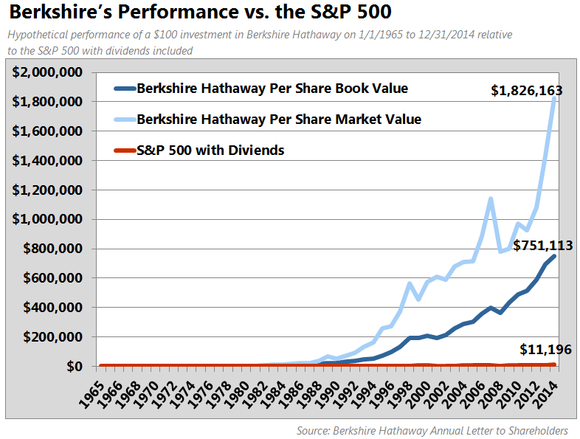
The final thing investors may have missed is actually the first thing in the letter: the table disclosing the performance of Berkshire Hathaway relative to the S&P 500. It has often been one of the most cited references, revealing just how incredibly Berkshire has performed over its lifetime.
So what's most noteworthy about this year's table? For the first time we're also shown not just the book value growth of Berkshire, but also its market value growth. In other words, we can see the growth of both its paper value and what the market has said its value is.
So what has that seemingly inconsequential difference of 2.2% between book value growth and market value growth meant over the past 50 years? When comparing a hypothetical $100 investment, words simply don't do it justice:
No one knows what the next 50 years will look like for Berkshire -- or anything else for that matter -- but we can all agree the past 50 have been truly remarkable.
Warren Buffett: This new technology is a "real threat"At the recent Berkshire Hathaway annual meeting, Warren Buffett admitted this emerging technology is threatening his biggest cash-cow. Buffett's fear can be your gain. Only a few investors are embracing this new market, which experts say will be worth over $2 trillion. Find out how you can cash in on this technology before the crowd catches on, by jumping onto one company that could get you the biggest piece of the action. Click here to access a free investor alert on the company we're calling the brains behind the technology.

Thursday, 5 March 2015


Very interesting article below on what went wrong with SAP project.


Price tag for troubled SAP project will skyrocket to nearly $1 billion, audit says


An 'overly ambitious design' and poor training are cited as reasons for the mess at a New York gas utility

The cost of finishing a massive SAP software overhaul at a New York gas utility will rise to nearly $1 billion from an original estimate of $383.8 million, a newly released audit report has found. 

National Grid's SAP upgrade went live in November 2012, nearly simultaneously with Hurricane Sandy, the massive storm that ravaged the East Coast. 

Immediately upon the go-live, the SAP system was wracked with issues, particularly related to payroll, with the chaos wrought by Sandy and the subsequent cleanup effort only exacerbating the situation.

National Grid ended up bringing in 450 additional contractors to work on the payroll problems, along with 400 to help out with issues related to supply chain and financial closes, according to the audit, which is dated July 25 but was released this week by the New York Public Service Commission.

Now the total cost for the project through the utility's fiscal 2015 is expected to be $945.1 million, the audit states. The system, which replaced multiple Oracle systems at National Grid, was supposed to be stabilized as of September, with updates to bring various modules up to current versions completed by the end of this year.

The audit goes into significant detail about the root causes for the implementation's woes. For one thing, National Grid "did not use vendors with a strong track record of US utility industry experience in SAP platform implementation," it states.
Initially, the utility hired Deloitte but later decided to switch partners, bringing in Ernst and Young along with Wipro. Also, in choosing SAP as the new platform, National Grid had only "very limited discussions" with other U.S. utilities about their experience with it, relying instead on assertions of National Grid UK, which had already moved to SAP, according to the audit. Moreover, "while Wipro had extensive experience in Europe, it had virtually no experience at the time implementing an SAP platform for utilities regulated in the US," it states.
Overeagerness on the part of National Grid also led to recklessness.

Some groups within National Grid raised questions about "problems with system and company readiness" before the switchover to the new system, but "that information was subsumed by a push to go live," according to the audit.

Even now, National Grid is failing to take full advantage of the SAP system's capabilities, relying on "complex Excel spreadsheets" for management reporting, it states.

A Wipro spokesman didn't immediately respond to a request for comment Friday. "We recognize the challenges National Grid faced and have worked continuously with the customer to address them," SAP spokesman Andy Kendzie said in an emailed statement Friday.
"It's important to understand that many of the issues referenced in the audit report date back to November 2012 when we initially launched SAP," National Grid spokeswoman Jackie Barry said via email. "There were many factors that led to those issues, but the system is now Price tag for troubled SAP project will skyrocket to nearly $1 billion, audit sayssubstantially stable."
In a letter released with the audit, National Grid said it didn't agree with all of its conclusions but "generally accepts" its recommendations.
The audit also includes a number of reasons National Grid gave for why the project stumbled, including an "overly ambitious design," lack of accountability, poor data quality from the legacy systems and ineffective training.
Company shareholders, and not ratepayers, will absorb the extra costs of fixing the system, according to the Public Service Commission.
Chris Kanaracus covers enterprise software and general technology breaking news for The IDG News Service. Chris' email address is Chris_Kanaracus@idg.com

Electric Motors Use 45% of Global Electricity, Europe Responding {+ Electric Motor Efficiency Infographic}

June 16th, 2011 by 

Interesting fact: today marks the passage of 45% of the year (yeah, time flies). 2nd interesting fact: electric motors account for ~45% of total global electricity consumption (yeah, that means electric motors are a beast of an energy user).
Are We Setting the Right Priorities to Address our Energy Challenges?
Electric motors are the single biggest consumer of electricity. They account for about two thirds of industrial power consumption and, as stated above, about 45% of global power consumption, according to a new analysis by the International Energy Agency (linked above).
Lighting is a distant second, consuming about 19%.
This means that almost every second power plant is producing electricity for the sole purpose of running motors.
However, as you have probably noticed, electric motors rarely form part of the intensive debate on our energy future (including here on CleanTechnica). Thousands of words and column inches are devoted to topics such as nuclear power, renewable energy, and electric vehicles, but rarely (if at all) do we discuss the fact that the majority of electric motors are inefficient, oversized, or running when they don’t need to be running.
As I’ve pointed out a number of times here on CleanTechnica, and have been wanting to focus on more, energy efficiency measures are critical to addressing the environmental and economic problems we face. Addressing the efficiency of electric motors, while not attractive to most of us, is an important topic someone (or many someones) needs/need to tackle.

Making Electric Motors More Efficient

Notably, ABB points out that using only existing technology, we can accomplish HUGE energy efficiency savings in this arena (check out their awesome new infographic on this below, which they’ve been kind enough to give us and sustainablog the lead on — click to enlarge it).
Today, the European Union is introducing new legislation which marks an important step in realizing some of these benefits, and which further highlights the potential to drastically reshape the world’s energy consumption profile. The infographic below (click to enlarge) illuminates what that legislation could mean in a pretty clear and fun way. Enjoy!
(Note, of course, that energy savings also result in tremendous financial savings and that energy efficiency upgrades in this case, as in so many, result in super fast returns on investment.)hElectric Motors Use 45% of Global Electricity, Europe Responding {+ Electric Motor Efficiency Infographic}

Source: http://cleantechnica.com/2011/06/16/electric-motors-consume-45-of-global-electricity-europe-responding-electric-motor-efficiency-infographic/


Saturday, 28 February 2015

SAP Innovation Video for Asset Management

Share your views on what you think of SAP EAM? What functionality would you like SAP to add.? SAP Innovation Video for Asset Management SAP SAP

EAM Web UI "how to" guide

 EAM Web UI "how to" guide
The focus of the EAM Simplification was (and is) on enhancing the WebUI with new and rich functionality as well as using the newest features of the underlying WebDynpro ABAP technology.


These improvements simplify the work of the users and enable maintenance planners and maintenance workers to use the EAM Web user interface to do their jobs more efficiently.

To find all the details on adjusting/enhancing the WebUI Applications to your users’ needs SAP created a “How to”-guide (EAM Web UI Implementation Guide EHP7).

The Version 2.0 (from August 2014) already covered:
  • How to get started with the SAP Web User Interface
  • How to change the Web Dynpro Configuration
  • How to adapt applications and how to personalize on user level
  • How to configure POWL e.g. to add fields or user actions
  • How to use side panels in the SAP EAM Web UI
  • Which BAdIs and User Exits are available

The new version 2.5 covers, in addition
  • object based navigation and launchpads
  • how to adjust the asset viewer

You can find this guide in SAP Developers Network or you can use this link to download the “How-to”-Guide right now via this link!

There is the opportunity to discuss all relevant EAM topics with the SAP experts during  the upcoming SAP-Centric EAM Conference, in Huntington Beach, CA, US on March 8-11th, 2015 - find details here!

Posted by Martin Janssen in Enterprise Asset Management (SAP EAM) on Feb 27, 2015 12:55:43 PM  
http://scn.sap.com/community/eam/blog/2015/02/27/eam-web-ui-how-to-guide?utm_medium=twitter&utm_source=twitterfeed

Thursday, 26 February 2015

Welcome to the Crystal


What do you think?

Wednesday, 25 February 2015

MobileEnterpriseStrategies.com: Kevin Benedict's Mobile Cyber Security News Weekly...

MobileEnterpriseStrategies.com: Kevin Benedict's Mobile Cyber Security News Weekly...: Welcome to the Mobile Cyber Security News Weekly, our newest online newsletter. Mobile Cyber Security will focus on the most interesting n...

Thursday, 19 February 2015


​The TrackingPoint 338TP, the Linux rifle that's accurate up to a mile

Summary:You'll find Linux everywhere, including in the most accurate rifles in the world.

I grew up in rural West Virginia, and I don't remember learning how to shoot. All I know is I was certainly shooting well before the time I was 8. I grew up in a gun culture, with many relatives in the military, and I went to school at West Virginia University, which won its 16th NCAA Rifle Championship in 2014. In short, I know guns and I know just how hard it is to shoot accurately at extreme ranges such as 1,000 yards. Even at my best, I was never able to do it reliably.

trackingpoint.png
(Image: TrackingPoint)
Or rather, it used to be extraordinarily hard to hit a target consistently at 1,000 yards or more. Now, thanks to Linux, TrackingPoint, an Austin, Texas business, will allow almost anyone to hit not just 1,000-yard targets, but also ones that are up to 1 mile, 1,760 yards, away.
This isn't science fiction or a stunt done that only works under indoor rifle range conditions. TrackingPoint Precision-Guided Firearms have been enabling shooters to hit targets beyond any range they could hit on their own for several years now.
This newest model, the 338TP, nicknamed the Mile Maker, which was introduced at the Consumer Electronics Show (CES) in Las Vegas in January, just extends this rifle line's range up to a mile. It works by using a combination of technologies.
First, the 338TP uses the .338 Lapua Magnum long-range rifle for its base. This rifle started as a design for a US Marine sniper rifle. Then, to acquire the target, the rifle uses a laser to enable you to "tag" your target. More than just a laser-targeting system, its sensors also track wind speed, direction, temperature, and barometric pressure. As serious shooters know, all of these factors must be taken into account for an accurate shot at great ranges.
This data is then passed on to the built-in Linux computer. Once you've tagged the target, the rifle will automatically track it. You then bring your reticule, the optical target-aiming point, to match the rifle's computed impact point. Once you've matched it up and you decide to take the shot, you pull the trigger and the TriggerLink computer works out all the details needed to hit the target. Thus, and this is surprising until you get used to it, there may be up to a second of delay between the time you pull the trigger and when the shot goes off.
So is it really that accurate? It works well enough that theUS Army is testing it. In one review, it was found that users of an older model were getting 70 percent first hit accuracy at 1,000 yards. A trained military rifleman, not a sniper, would hit about 5 percent of the time.
In a word, that's impressive.
Of course, for that kind of accuracy, you're going to pay a real premium. While final pricing hasn't been set yet, the 338TP won't go on sale until the second quarter of 2015, and it's expected to price out at over $40,000. Even the entry-level TrackingPoint rifle, thePrecision-Guided Semi-Auto 5.56, starts at $7,495.
Oh, and the ammo: You get 200 rounds with the rifle, which runs at about $8 a round. When you're shooting at a distance, everything, and I mean everything, counts for accuracy, including the ammo.
You can also get smartglasses, the Shotglass, and Heads Up Display software, which can be used with smartphones and tablets, to let you shoot at targets without actually sighting from the rifle itself.
The 338TP certainly isn't normally what you think of when you think of a Linux-powered device. It just goes to show how Linux can be used to make almost any device better.
Topics: HardwareLinux