What is your experience with Prometheus?

Monday, 23 March 2015

Monday, 9 March 2015
3 Critical Things You Missed in Warren Buffett's Letter
Just to mix it up on my blog I posted and interesting article I came across on Warren Buffett and Berkshire Hathaway shares. I have some of these shares through my SMSF, thus the interest.
3 Critical Things You Missed in Warren Buffett's Letter
By Patrick Morris | More Articles
March 8, 2015 | Comments (0)
Media outlets were abuzz this weekend following the release of Warren Buffett's 50th letter to Berkshire Hathaway (NYSE: BRK-A ) (NYSE: BRK-B ) shareholders.
While it's important to see what Buffett has to say about who his possible successor may be, how the next 50 years of Berkshire could look, and what he thinks about the economy and investments in general, it's also critical to remember that Berkshire Hathaway is Buffett's business (or really, businesses), and a glance at its operating results reveals three important things that investors in Berkshire Hathaway need to be aware of.
Crossing $80 billion
It's no secret that the insurance business has been the key engine driving Berkshire's success through the years. Buffett has used the insurance float -- the money taken in through premiums that the insurer holds before ultimately being paid out in claims -- to make many of the incredible investments that have turned Berkshire Hathaway into the behemoth it is today.
It's no secret that the insurance business has been the key engine driving Berkshire's success through the years. Buffett has used the insurance float -- the money taken in through premiums that the insurer holds before ultimately being paid out in claims -- to make many of the incredible investments that have turned Berkshire Hathaway into the behemoth it is today.

Image source: The Motley Fool.
He notes that insurance is "Berkshire's core operation," and National Indemnity, the first insurer Buffett acquired, was purchased for $8.6 million back in 1967 and now has a net worth of an incredible $111 billion, "which exceeds that of any other insurer in the world."
But one of the most fascinating things about the insurance business at Berkshire is that its expansion has shown no sign of slowing down anytime soon.
Consider for a moment how much its float has grown since 1970:

While Buffett noted in this year's letter that "[f]urther gains in float will be tough to achieve," he said the identical thing in the 2013 letter to shareholders. Yet in 2014 its float grew by nearly $7 billion -- a gain of more than 8.5%, so take that statement with a hefty grain of salt.
And as a last note regarding the insurance businesses at Berkshire, we also learned for the 12th consecutive year that Berkshire recorded an underwriting profit, hitting roughly $2.7 billion in 2014 and nearly $24 billion in total over the last dozen years.
To provide a little context as to how remarkable this is, consider Buffett's words from his 2010 Letter to Shareholders:
State Farm, by far the country's largest insurer and a well-managed company, has incurred an underwriting loss in seven of the last 10 years. During that period, its aggregate underwriting loss was more than $20 billion.
All of this is to say, when you consider that Buffett says insurance "has been the engine that has propelled our expansion since 1967," it doesn't appear that engine will slow down anytime soon.
The Powerhouse powers on
It's also important to recognize that Berkshire Hathaway isn't only an insurance company. It's a collection of companies across a litany of different industries, including:
It's also important to recognize that Berkshire Hathaway isn't only an insurance company. It's a collection of companies across a litany of different industries, including:
- Burlington Northern Santa Fe, which "operates one of the largest railroad systems in North America."
- Berkshire Hathaway Energy Company ("BHE") designated as "an international energy holding company."
- The Marmon Group, "an international association of approximately 185 manufacturing and service businesses."
- The Lubrizol Corporation, "a specialty chemical company that produces and supplies chemical products for transportation, industrial, and consumer markets."
- 3 Critical Things You Missed in Warren Buffett's Letter, "an industry leader in the metal cutting tools business."
And while there are more than 70 other non-insurance businesses under the Berkshire umbrella, Buffett affectionately refers to these as the "Powerhouse Five."

Image source: Flickr / Greg Gjerdingen.
What investors see with these five is that collectively their pre-tax earnings increased to $12.4 billion in 2014, a 15% gain over 2013 levels. Buffett himself notes just how remarkable this is when you consider that only Berkshire Hathaway Energy was owned by Berkshire 10 years ago, and it earned just $393 million at the time.
While a railroad, an energy company, a collection of manufacturing and servicing business, a chemicals firm, and a company in "the metal cutting tools business" won't raise many eyebrows, what they will raise are profits, to the delight of Buffett and Berkshire shareholders alike.
The truly incredible investment
The final thing investors may have missed is actually the first thing in the letter: the table disclosing the performance of Berkshire Hathaway relative to the S&P 500. It has often been one of the most cited references, revealing just how incredibly Berkshire has performed over its lifetime.
The final thing investors may have missed is actually the first thing in the letter: the table disclosing the performance of Berkshire Hathaway relative to the S&P 500. It has often been one of the most cited references, revealing just how incredibly Berkshire has performed over its lifetime.
So what's most noteworthy about this year's table? For the first time we're also shown not just the book value growth of Berkshire, but also its market value growth. In other words, we can see the growth of both its paper value and what the market has said its value is.

So what has that seemingly inconsequential difference of 2.2% between book value growth and market value growth meant over the past 50 years? When comparing a hypothetical $100 investment, words simply don't do it justice:
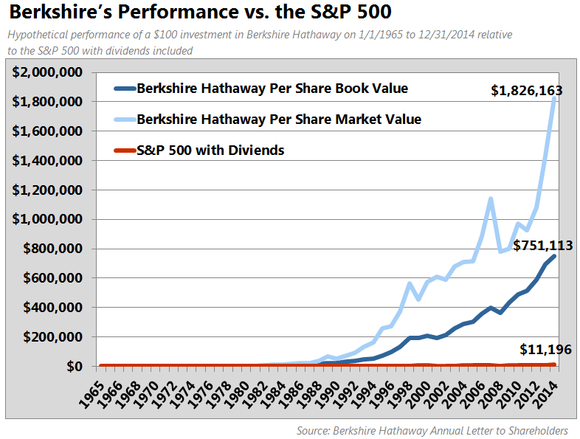
No one knows what the next 50 years will look like for Berkshire -- or anything else for that matter -- but we can all agree the past 50 have been truly remarkable.
Warren Buffett: This new technology is a "real threat"At the recent Berkshire Hathaway annual meeting, Warren Buffett admitted this emerging technology is threatening his biggest cash-cow. Buffett's fear can be your gain. Only a few investors are embracing this new market, which experts say will be worth over $2 trillion. Find out how you can cash in on this technology before the crowd catches on, by jumping onto one company that could get you the biggest piece of the action. Click here to access a free investor alert on the company we're calling the brains behind the technology.
Friday, 6 March 2015
Thursday, 5 March 2015
Very interesting article below on what went wrong with SAP project.
Price tag for troubled SAP project will skyrocket to nearly $1 billion, audit says
An 'overly ambitious design' and poor training are cited as reasons for the mess at a New York gas utility
The cost of finishing a massive SAP software overhaul at a New York gas utility will rise to nearly $1 billion from an original estimate of $383.8 million, a newly released audit report has found.
National Grid's SAP upgrade went live in November 2012, nearly simultaneously with Hurricane Sandy, the massive storm that ravaged the East Coast.
Immediately upon the go-live, the SAP system was wracked with issues, particularly related to payroll, with the chaos wrought by Sandy and the subsequent cleanup effort only exacerbating the situation.
National Grid ended up bringing in 450 additional contractors to work on the payroll problems, along with 400 to help out with issues related to supply chain and financial closes, according to the audit, which is dated July 25 but was released this week by the New York Public Service Commission.
Now the total cost for the project through the utility's fiscal 2015 is expected to be $945.1 million, the audit states. The system, which replaced multiple Oracle systems at National Grid, was supposed to be stabilized as of September, with updates to bring various modules up to current versions completed by the end of this year.
The audit goes into significant detail about the root causes for the implementation's woes. For one thing, National Grid "did not use vendors with a strong track record of US utility industry experience in SAP platform implementation," it states.
Initially, the utility hired Deloitte but later decided to switch partners, bringing in Ernst and Young along with Wipro. Also, in choosing SAP as the new platform, National Grid had only "very limited discussions" with other U.S. utilities about their experience with it, relying instead on assertions of National Grid UK, which had already moved to SAP, according to the audit. Moreover, "while Wipro had extensive experience in Europe, it had virtually no experience at the time implementing an SAP platform for utilities regulated in the US," it states.
Overeagerness on the part of National Grid also led to recklessness.
Some groups within National Grid raised questions about "problems with system and company readiness" before the switchover to the new system, but "that information was subsumed by a push to go live," according to the audit.
Even now, National Grid is failing to take full advantage of the SAP system's capabilities, relying on "complex Excel spreadsheets" for management reporting, it states.
A Wipro spokesman didn't immediately respond to a request for comment Friday. "We recognize the challenges National Grid faced and have worked continuously with the customer to address them," SAP spokesman Andy Kendzie said in an emailed statement Friday.
"It's important to understand that many of the issues referenced in the audit report date back to November 2012 when we initially launched SAP," National Grid spokeswoman Jackie Barry said via email. "There were many factors that led to those issues, but the system is now Price tag for troubled SAP project will skyrocket to nearly $1 billion, audit sayssubstantially stable."
In a letter released with the audit, National Grid said it didn't agree with all of its conclusions but "generally accepts" its recommendations.
The audit also includes a number of reasons National Grid gave for why the project stumbled, including an "overly ambitious design," lack of accountability, poor data quality from the legacy systems and ineffective training.
Company shareholders, and not ratepayers, will absorb the extra costs of fixing the system, according to the Public Service Commission.
Chris Kanaracus covers enterprise software and general technology breaking news for The IDG News Service. Chris' email address is Chris_Kanaracus@idg.com
Wednesday, 4 March 2015
Maintenance Talk: Using Reliability Centered Maintenance and Conditi...
Using Reliability Centered Maintenance and Condition Monitoring to drive Reliability ImprovementMaintenance Talk: Using Reliability Centered Maintenance and Conditi...: A 40 minute video from the International Maintenance Conference (IMC-211) delivered by Keith Berriman, P.Eng., CMRP, Director of Engineer...http://maintenance-talk.blogspot.com.au/2012/07/using-reliability-centered-maintenance.html
Electric Motors Use 45% of Global Electricity, Europe Responding {+ Electric Motor Efficiency Infographic}
June 16th, 2011 by Zachary Shahan
Interesting fact: today marks the passage of 45% of the year (yeah, time flies). 2nd interesting fact: electric motors account for ~45% of total global electricity consumption (yeah, that means electric motors are a beast of an energy user).
Interesting fact: today marks the passage of 45% of the year (yeah, time flies). 2nd interesting fact: electric motors account for ~45% of total global electricity consumption (yeah, that means electric motors are a beast of an energy user).
Are We Setting the Right Priorities to Address our Energy Challenges?
Electric motors are the single biggest consumer of electricity. They account for about two thirds of industrial power consumption and, as stated above, about 45% of global power consumption, according to a new analysis by the International Energy Agency (linked above).
Lighting is a distant second, consuming about 19%.
This means that almost every second power plant is producing electricity for the sole purpose of running motors.
However, as you have probably noticed, electric motors rarely form part of the intensive debate on our energy future (including here on CleanTechnica). Thousands of words and column inches are devoted to topics such as nuclear power, renewable energy, and electric vehicles, but rarely (if at all) do we discuss the fact that the majority of electric motors are inefficient, oversized, or running when they don’t need to be running.
As I’ve pointed out a number of times here on CleanTechnica, and have been wanting to focus on more, energy efficiency measures are critical to addressing the environmental and economic problems we face. Addressing the efficiency of electric motors, while not attractive to most of us, is an important topic someone (or many someones) needs/need to tackle.
Making Electric Motors More Efficient
Notably, ABB points out that using only existing technology, we can accomplish HUGE energy efficiency savings in this arena (check out their awesome new infographic on this below, which they’ve been kind enough to give us and sustainablog the lead on — click to enlarge it).
Today, the European Union is introducing new legislation which marks an important step in realizing some of these benefits, and which further highlights the potential to drastically reshape the world’s energy consumption profile. The infographic below (click to enlarge) illuminates what that legislation could mean in a pretty clear and fun way. Enjoy!
(Note, of course, that energy savings also result in tremendous financial savings and that energy efficiency upgrades in this case, as in so many, result in super fast returns on investment.)hElectric Motors Use 45% of Global Electricity, Europe Responding {+ Electric Motor Efficiency Infographic}
Source: http://cleantechnica.com/2011/06/16/electric-motors-consume-45-of-global-electricity-europe-responding-electric-motor-efficiency-infographic/
Source: http://cleantechnica.com/2011/06/16/electric-motors-consume-45-of-global-electricity-europe-responding-electric-motor-efficiency-infographic/

Subscribe to:
Comments (Atom)